Conference presentation
Buying Under Fire: How the 2022 Rearmament Shock Reshaped Competition and Supplier Selection in European Defense Procurement
- 29th International Conference on Economics and Security (ICES 2026), University of Information Technology and Management (UITM)
- Rzeszów, Poland
I presented my research on how Europe’s post-2022 rearmament changed competition and supplier selection in defense procurement.
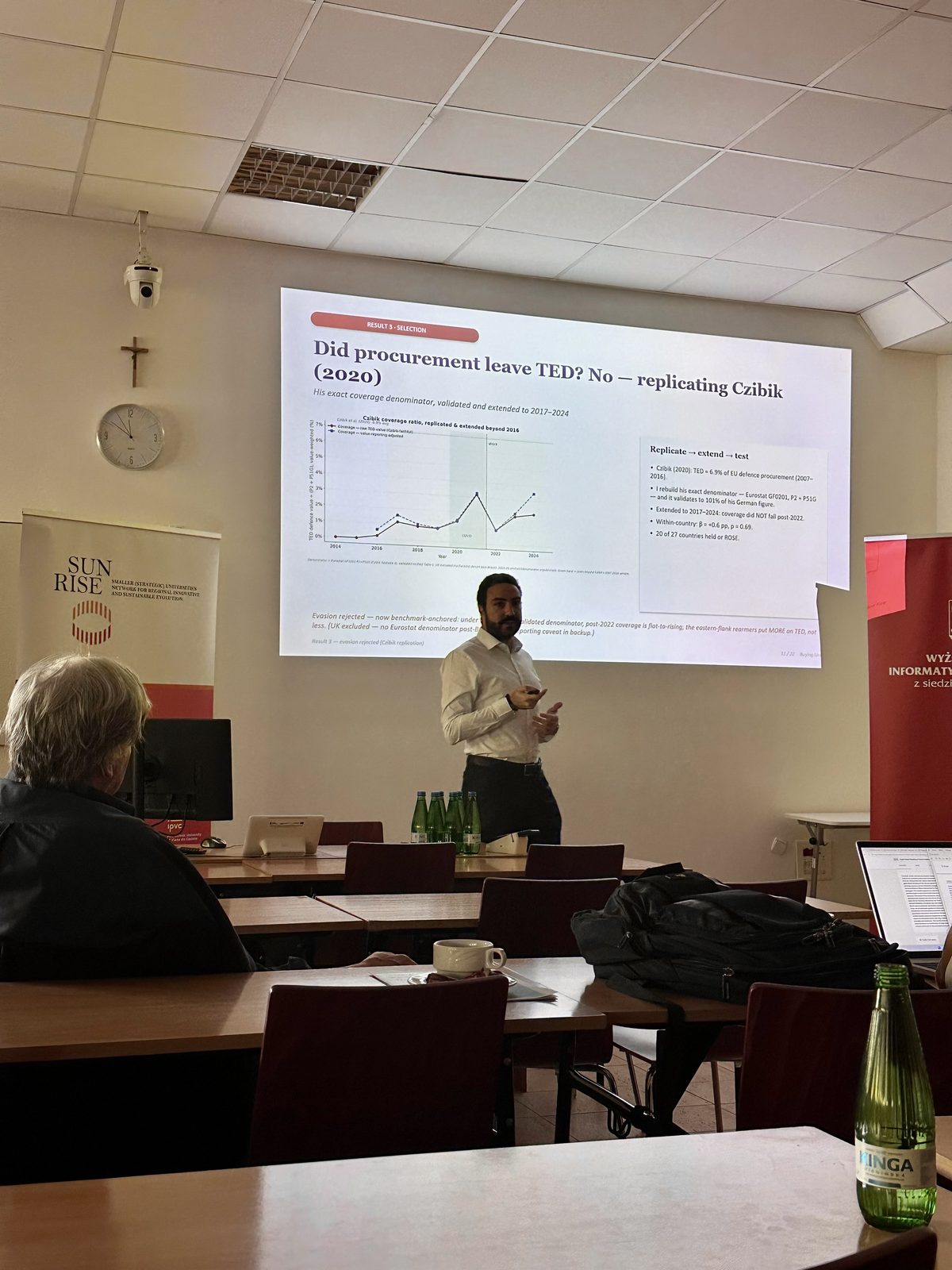
Abstract (revised May 27, 2026). Russia’s full-scale invasion of Ukraine triggered the largest European defense build-up since the Cold War, yet we know little about how this shock changed the actual conduct of defense procurement. This paper examines whether Europe’s rearmament translated into more competitive procurement, greater use of national-security exemptions, or stronger reliance on incumbent defense suppliers. Using TED procurement records covering EU member states, the United Kingdom, and Norway from 2014 to 2026, I combine a tender-level difference-in-differences design with a firm-level supplier-matching pipeline. The analysis shows that defense procurement shifted sharply toward negotiated procedures without prior publication after 2022. The effect is not driven by emergency purchasing, but mainly by technical-monopoly justifications, suggesting a move toward sole-supplier awards to established firms. A coverage-ratio test finds no evidence that procurement systematically migrated off TED into Article 346 exemptions. At the firm level, contract value became increasingly concentrated among major European defense primes and firms previously embedded in EDF and EDIDP networks, while lower-value supplier entry expanded in some segments. The findings show that Europe’s wartime procurement response did not simply expand defense markets. It reinforced incumbent industrial structures through legally compliant but weakly competitive procurement channels.